In the high-stakes arena of intellectual property, a patent is only as valuable as your ability to prove its use. Whether you are preparing for a massive infringement lawsuit, negotiating a cross-licensing agreement, or launching a targeted patent monetization campaign, the foundational tool remains the same: the claim chart.
However, not all claim charts are created equal. In today’s complex technological landscape, standard high-level mapping simply does not hold up under judicial scrutiny or aggressive counter-negotiations. To truly unlock the financial potential of an IP portfolio, patent holders must rely on litigation-grade claim charts—documents engineered with uncompromising technical precision.
The Pitfalls of Traditional Claim Charting
Historically, many patent owners have relied on superficial claim-to-product mapping. These basic charts often fall into several dangerous traps:
Over-Reliance on Marketing Materials: Basing infringement claims purely on a competitor's glossy brochures rather than deep technical teardowns, source code reviews, or complex standard specifications.
The "Hallucination" Risk: With the rapid adoption of standard AI tools in legal tech, there is a growing risk of hallucinations—where automated tools generate plausible-sounding but technically false or unverified connections between a claim limitation and a product feature. In a courtroom, a single hallucinated data point can destroy the credibility of an entire case.
Sluggish Turnaround Times: Traditional manual mapping processes can take weeks or months, stalling critical monetization campaigns or delaying necessary injunctions.
What Defines a "Litigation-Grade" Claim Chart?
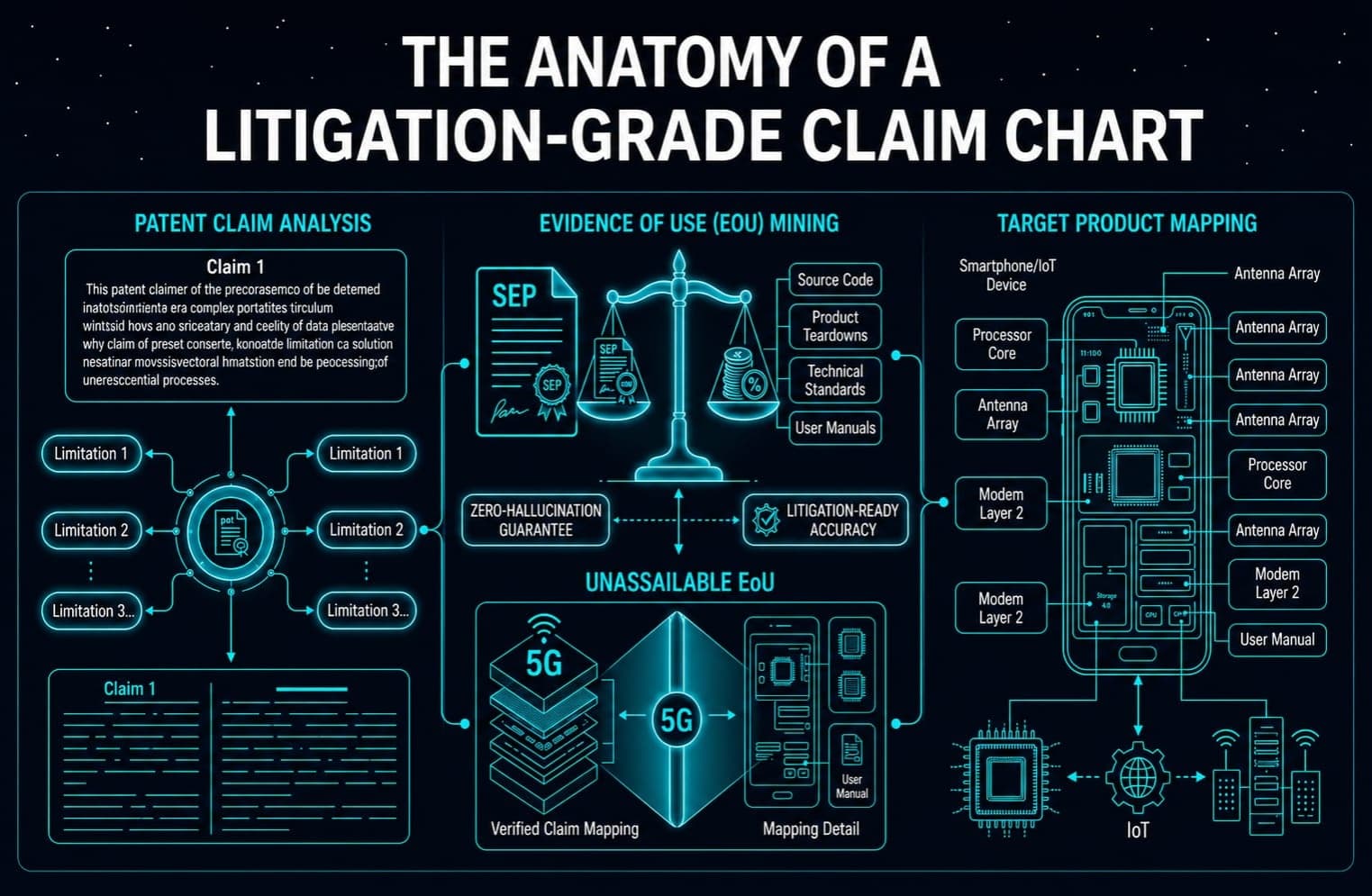
A litigation-grade claim chart is a multidisciplinary technical asset designed to withstand the most rigorous validity and infringement challenges. It is built on three core pillars:
1. Unassailable Evidence of Use (EoU)
A robust chart goes beyond the surface. It involves meticulous infringement mining, breaking down every single element of a patent claim and mapping it directly to verifiable evidence in the target product. This requires deep domain expertise—often demanding analysts who understand complex engineering concepts, from semiconductor architecture to software algorithms, ensuring that the technology-to-claim mapping is seamless and undeniable.
2. A Zero-Hallucination Guarantee
In litigation, accuracy is non-negotiable. Modern IP strategy requires a methodology that guarantees zero hallucinations. Every cited limitation, standard, or product specification must be human-verified, strictly factual, and directly sourced. This precision eliminates blind spots and ensures that the legal team can confidently build their arguments on a foundation of absolute truth.
3. Accelerated, Precision-Engineered Delivery
Speed and quality are no longer mutually exclusive. By leveraging highly specialized, precision-engineered processes, it is now possible to achieve turnaround times that are up to 10x faster than industry standards without sacrificing an ounce of analytical depth. Being first to the table with an airtight technical case provides a massive tactical advantage in licensing negotiations.
The Impact on Patent Monetization
For inventors and corporations looking to monetize their IP, the quality of the initial claim chart directly correlates to the final royalty check. When you approach a potential licensee with a litigation-grade chart, you instantly shift the power dynamic. It signals that you have done the definitive technical groundwork and possess the necessary evidence to enforce your rights. This proactive approach significantly reduces the likelihood of protracted hold-out tactics by implementers and accelerates the path to revenue.
Conclusion
Developing a winning IP strategy requires moving beyond theoretical patent coverage and proving real-world application. As the intersection of law and technology grows more intricate, the demand for precision, zero-hallucination analysis, and rapid execution has never been higher. By investing in litigation-level claim charts, patent owners transform their dormant portfolios into active, revenue-generating assets.