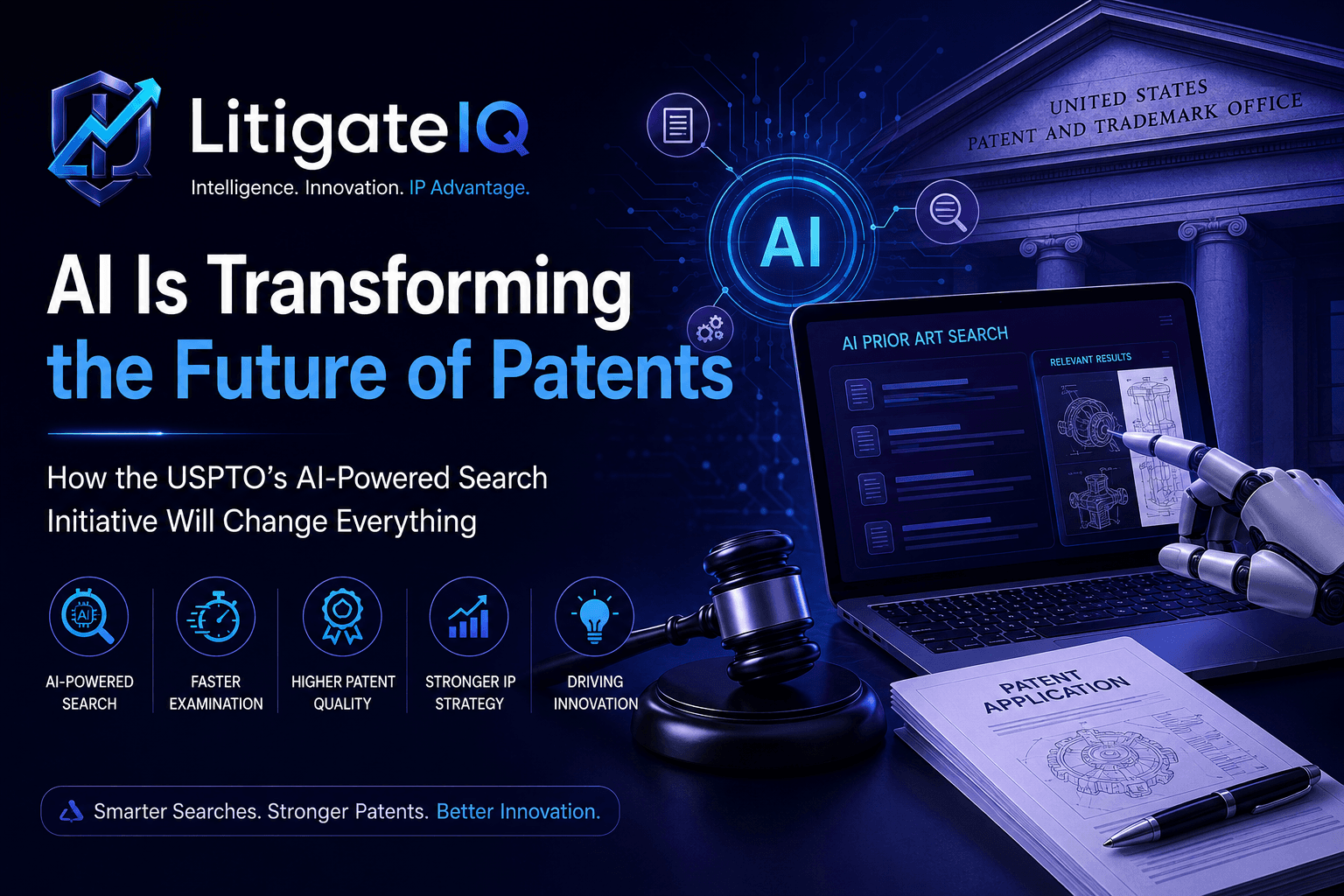
The world of intellectual property is entering a new era. The United States Patent and Trademark Office (USPTO) has officially expanded its AI-powered patent search initiative, marking one of the biggest technological shifts in modern patent examination history.
With the expansion of the updated ASAP! program, artificial intelligence is now being integrated directly into the patent review workflow. Before a patent examiner even begins reviewing an application, AI systems can generate prior-art search results to help identify existing technologies and similar inventions.
This development is expected to significantly reshape how patents are drafted, reviewed, and prosecuted across the United States.
What Is Changing at the USPTO?
Traditionally, patent examination relied heavily on manual prior-art searches conducted by patent examiners. These searches are essential because they determine whether an invention is truly novel and eligible for patent protection.
Under the new AI-assisted framework, the USPTO is accelerating this process by using machine learning and advanced search algorithms to analyze massive patent databases more efficiently.
The goal is to improve:
- Patent examination speed
- Search accuracy
- Patent quality
- Examiner productivity
- Innovation efficiency
This move also reflects a broader trend of governments and institutions adopting AI to modernize complex administrative systems.
Why This Matters for Startups and Innovators
The impact of AI-driven patent examination extends far beyond patent offices. It directly affects startups, founders, research organizations, technology companies, and patent professionals.
Businesses operating in sectors such as:
- Artificial Intelligence
- SaaS
- Biotechnology
- Semiconductor Technology
- Deep Tech
- Robotics
- Healthcare Innovation
will need to adapt quickly to the evolving patent landscape.
As AI tools become more effective at identifying prior art, patent applications will face higher scrutiny regarding novelty and technical differentiation. Weak or poorly drafted applications may become easier to reject.
This means companies must focus more on:
- Strong patent drafting
- Clear technical claims
- Comprehensive innovation disclosure
- Strategic intellectual property planning
The Rise of AI-Assisted Patent Prosecution
The integration of AI into patent systems signals the beginning of AI-assisted patent prosecution.
Patent attorneys and intellectual property professionals are increasingly expected to work alongside AI-powered research tools to:
- Conduct faster patent searches
- Identify overlapping inventions
- Analyze competitive patent landscapes
- Improve filing strategies
- Reduce prosecution delays
Organizations that embrace AI-enhanced IP strategies early could gain a significant competitive advantage in the global innovation economy.
The Future of Intellectual Property
The intersection of artificial intelligence and intellectual property is no longer theoretical. It is actively reshaping how innovation is protected worldwide.
The USPTO’s latest initiative demonstrates that AI will become a core component of future patent ecosystems. As patent offices continue adopting automation and machine learning technologies, businesses must evolve their intellectual property strategies to stay competitive.
The future of patents will not replace human expertise — but it will certainly augment it with AI-driven intelligence and speed.
Final Thoughts
The expansion of AI-powered patent examination at the USPTO represents a major milestone for the future of innovation and intellectual property management.
For startups, inventors, and technology leaders, this is more than just policy news. It is a signal that the global patent landscape is becoming smarter, faster, and more data-driven.
The companies that prepare now for AI-assisted patent systems will be better positioned to protect innovation, accelerate growth, and lead the next generation of technological advancement.