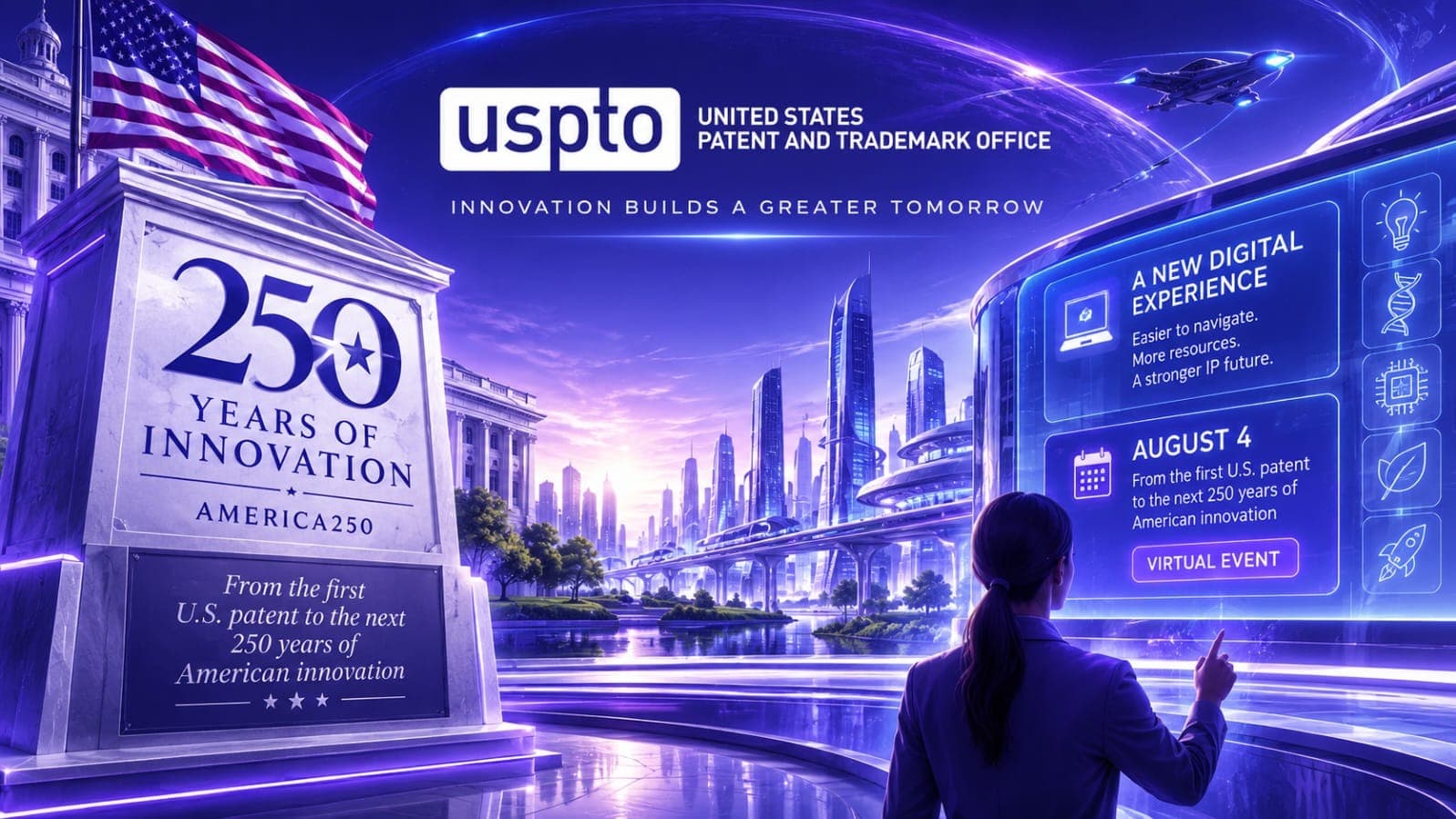
The U.S. Patent and Trademark Office marked America's 250th anniversary with three developments in a single week: a ceremonial patent and trademark signing at the Department of Commerce, the launch of a redesigned USPTO.gov homepage, and an August 4 virtual event tracing the patent system from its first grant to its next 250 years.
Individually modest, together the three announcements sketch the agency's current direction: celebrating the patent system's history while modernizing how the public interacts with it.
A ceremonial signing for America's 250th anniversary
On July 23, the USPTO held a ceremonial patent and trademark signing commemorating the nation's 250th birthday. The ceremony took place at the Commerce Research Library in Washington, D.C., the agency's home for more than three decades, and was led by USPTO Director John A. Squires, who framed the occasion as a celebration of "the bold ideas that drive our great nation forward."
The agency also used the ceremony to unveil the latest entry in its Inventor Collectible Trading Card Series: a card honoring Commerce Secretary Howard W. Lutnick, who is named on more than 500 patents. Special America250 editions of the series, including cards for Alexander Graham Bell and George Washington, are being issued through the anniversary year. Patents and trademarks requested with the agency's new "250" logo cover design will be issued through December 29, 2026.
The timing carries its own history. The first U.S. patent was granted on July 31, 1790, to Samuel Hopkins for an improved process for making potash, and it was signed by President George Washington. The first federal trademark registration followed on October 25, 1870, issued to the Averill Chemical Paint Company.
A redesigned USPTO.gov homepage
The same day, the agency unveiled a modernized homepage design for USPTO.gov. The update puts services and resources front and center, with a cleaner layout intended to make it easier for users to find information, track applications, and manage their intellectual property portfolios.
According to the agency, the redesign followed research into how visitors actually use the site, and it forms part of the broader federal effort to improve digital public services. A feedback link on the homepage will collect user input for further iterations, so the design practitioners see today is likely to keep evolving rather than remain a fixed endpoint.
August 4: from the first patent to the next 250 years
The anniversary program continues next week with a virtual event on August 4, 2026, from 1 to 2 p.m. ET, titled "From the first U.S. patent to the next 250 years of American innovation." The event marks the 236th anniversary of the Hopkins patent and is structured in three parts: Director Squires on why the first patent matters in the nation's 250th year, USPTO lead historian Rebekah Oakes on the birth of the American patent system, and a moderated panel of working inventors on the next 250 years of innovation. Registration is open on the USPTO event page.
Why this matters for IP professionals
For practitioners, the ceremony is symbolism, but the digital modernization is operational. The USPTO has been steadily rebuilding its public-facing systems, from filing interfaces to open data access, and a homepage shaped by usage research changes how quickly applicants and their counsel reach forms, status tools, and portfolio resources. Teams managing large U.S. portfolios should expect the agency's digital services to keep consolidating, which is one more reason disciplined patent portfolio analysis belongs in the annual workflow rather than only in litigation.
The modernization push also raises the bar on the documents the system ingests. As examination and filing interfaces digitize further, cleanly drafted applications move through them with less friction, which makes front-end investment in strong patent drafting more valuable, not less.
Finally, the anniversary framing is a useful reminder of the system's scale: nearly 13 million U.S. patents granted since 1790, with examination practice now changing faster than at any point in that history. Our analysis of how AI is transforming the US patent system in 2026 covers the examination side of that trajectory in detail.