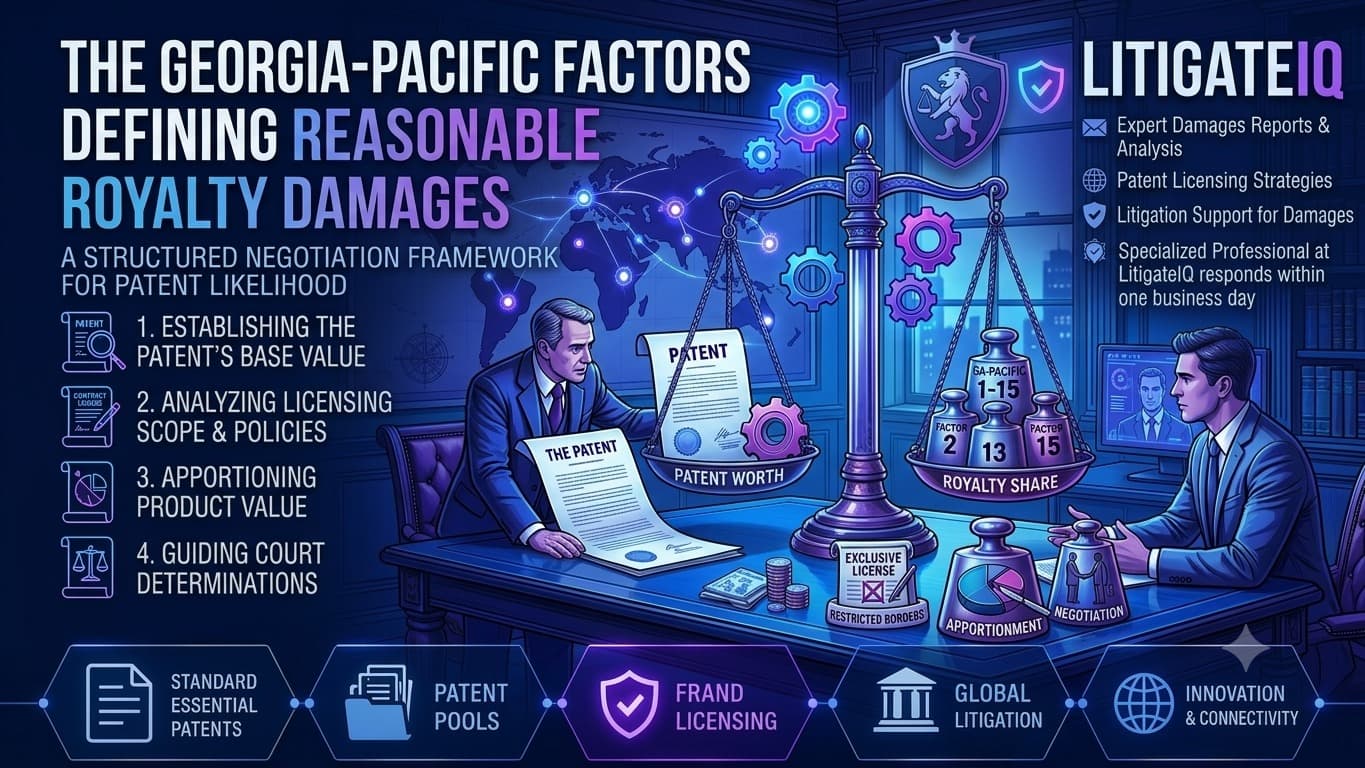
The Georgia-Pacific factors are a set of 15 criteria that US courts use to calculate reasonable royalty damages in patent infringement cases. Established in a 1970 federal decision, they structure the hypothetical negotiation between patent owner and infringer, and they remain the standard analytical framework for patent damages today.
The framework takes its name from Georgia-Pacific Corp. v. United States Plywood Corp., 318 F. Supp. 1116 (S.D.N.Y. 1970). In that decision, the Southern District of New York catalogued the evidentiary considerations that bear on setting a reasonable royalty under 35 U.S.C. § 284, and courts have applied that catalogue ever since.
What are the Georgia-Pacific factors?
Patent damages under § 284 come in two main forms: lost profits and a reasonable royalty. When a patent owner cannot prove lost profits, the court awards a royalty sized to what the parties would have agreed on in a hypothetical negotiation held at the time the infringement began. The Georgia-Pacific factors are the checklist courts and damages experts use to reconstruct that negotiation: what the patent was worth, how the parties were positioned, and how much of the product's profit the invention actually drove.
The 15 Georgia-Pacific factors, explained
#FactorWhat it asks in practice1Established royalties for the patent in suitHas this patent been licensed before, and at what rate?2Rates paid for comparable patentsWhat do licenses for similar patents in the field cost?3Nature and scope of the licenseExclusive or non-exclusive? Restricted by territory or field of use?4Licensor's policy to preserve its monopolyDoes the patent owner refuse licenses, or license only on strict terms?5Commercial relationship of the partiesAre licensor and licensee competitors in the same market?6Effect on sales of other productsDoes the invention drive convoyed sales of non-patented products?7Duration of the patent and the licenseHow much protection was left when the infringement began?8Profitability and commercial successHow successful is the product that embodies the patent?9Advantages over old modes or devicesWhat does the invention improve on, and by how much?10Nature of the invention and its benefitsHow significant is the invention to the people who use the product?11Extent of the infringer's useHow thoroughly did the infringer use the invention, and what was that use worth?12Customary profit share in the industryWhat royalty share is customary in comparable businesses?13Profit attributable to the inventionWhat share of profit comes from the invention rather than other features, the apportionment question?14Opinion testimony of qualified expertsWhat do the damages experts on each side conclude?15The hypothetical negotiation outcomeWhat would willing, prudent parties have agreed to when the infringement began?
How do courts apply the factors in litigation?
In practice, the factors organize the damages expert report. Each side's expert maps the evidence onto the relevant factors, constructs a royalty rate and base, and defends the result under cross-examination. Courts then test whether the analysis is genuinely tied to the facts of the case. In Lucent Technologies, Inc. v. Gateway, Inc., 580 F.3d 1301 (Fed. Cir. 2009), the Federal Circuit affirmed a lump-sum reasonable royalty of roughly $358 million against Microsoft after an extensive factor-by-factor review, showing how much weight a well-supported Georgia-Pacific analysis can carry.
The framework also disciplines what experts may not do. In Uniloc USA, Inc. v. Microsoft Corp., 632 F.3d 1292 (Fed. Cir. 2011), the Federal Circuit rejected the 25 percent rule of thumb, a once-common shortcut that started royalty calculations at a quarter of the infringer's expected profit, because it failed to tie the royalty to the facts of the case. The lesson for litigants is that every factor invoked must be supported by case-specific evidence, not rules of thumb.
When are the factors used outside a trial?
The Georgia-Pacific framework shapes value long before a jury is involved:
Damages expert reports. Both sides build their Rule 26 reports around the factors, and Daubert motions attack the factor analysis directly.
Settlement and mediation. The factors give each side a structured way to argue what a case is worth, which is why settlement positions often read like abbreviated expert reports.
Licensing negotiations. Factors 1, 2, and 12, covering established and comparable royalties, anchor real-world rate discussions between willing parties.
Patent acquisition pricing. Buyers pricing a portfolio ask the same question factor 15 asks: what would a willing licensee pay for these rights?
What do the factors have to do with claim charts?
Damages analysis starts from infringement, and infringement is proven element by element. The litigation-grade claim charts that establish each accused feature are the same documents that later feed the damages case: factor 11, the extent of the infringer's use, is proven with exactly the product evidence an evidence of use chart documents. Factor 13, apportionment, depends on knowing precisely which claim elements read on which product features, again claim-chart territory. Our article on litigation-grade claim charts and patent revenue covers that foundation in detail.
Royalty analysis also increasingly happens in court rather than only at the negotiating table. When judges set global rates for standard essential patents, as in the $392 million Samsung v. ZTE ruling, the reasoning echoes the same Georgia-Pacific logic of comparables, apportionment, and hypothetical bargaining positions.
Key takeaways
The Georgia-Pacific factors are the standard US framework for reasonable royalty patent damages, originating in a 1970 district court decision.
Every factor must be proven with case-specific evidence; shortcuts like the 25 percent rule have been rejected by the Federal Circuit.
The same factors drive expert reports, settlement posture, licensing rates, and acquisition pricing.
Strong damages cases are built on strong infringement evidence, which is why claim charts and evidence of use analysis come first.
If you are pricing a patent, preparing for licensing discussions, or building a litigation record, start with the evidence. A specialized patent professional at LitigateIQ responds within one business day.